/ Blog
A Complete Guide to AML Compliance Audits
/ Written by Andria Georgiou
February 25, 2026

An AML audit is one of the most critical control mechanisms within a modern Anti-Money Laundering (AML) and Counter-Terrorist Financing (CFT) compliance framework. As regulatory scrutiny intensifies across jurisdictions in 2026, independent AML testing has shifted from a procedural requirement to a central governance safeguard.
Financial institutions, fintech firms, payment providers, DNFBPs, and other regulated entities are expected to demonstrate that their AML compliance programs are not only documented but operationally effective. An AML compliance audit provides independent assurance that internal controls, risk assessments, customer due diligence procedures, transaction monitoring systems, and suspicious activity reporting processes function in line with regulatory expectations.
This guide provides a comprehensive overview of AML audits, including definitions, regulatory requirements, audit processes, checklists, reporting standards, enforcement trends, and practical preparation guidance for compliance professionals.
What Is AML? Definition and Regulatory Framework
Anti-Money Laundering (AML) refers to the regulatory and operational measures designed to prevent criminals from disguising illegally obtained funds as legitimate income. AML frameworks operate alongside Counter-Terrorist Financing (CFT) and sanctions compliance regimes to protect the integrity of the financial system.
AML regulatory frameworks are shaped by standards issued by the Financial Action Task Force (FATF) and implemented through national legislation and supervisory guidance. Institutions are required to establish internal controls proportionate to their AML risk exposure. Core components typically include:
Customer Due Diligence (CDD)
Enhanced Due Diligence (EDD)
Ongoing transaction monitoring
Suspicious activity reporting (SAR)
Sanctions screening
Governance oversight
Staff training and record retention
An AML audit evaluates whether these components are appropriately designed and operating effectively.
What Is an AML Audit?
An AML audit is an independent, risk-based review of an organization’s AML/CFT compliance framework. It assesses whether policies, procedures, systems, and internal controls are aligned with regulatory requirements and effectively mitigate financial crime risk.
Unlike routine compliance testing, which may examine specific control samples, an AML compliance audit evaluates the entire AML framework. It assesses governance, risk assessment methodologies, operational controls, monitoring systems, reporting mechanisms, and remediation processes.
Key Objectives of an AML Audit
An AML audit is designed to determine:
Whether the AML compliance framework is appropriately designed.
Whether AML controls operate effectively in practice.
Whether deficiencies are identified, escalated, and remediated in a timely manner.
Independent AML audits may be conducted internally by the audit function or externally by specialized providers such as AML Reactor, which offer objective validation and benchmarking against industry standards.
AML Audit vs Financial Audit
Although AML audits and financial audits may occur within the same institution, they serve distinct purposes.
Aspect | AML Audit | Financial Audit |
|---|---|---|
Primary Objective | Evaluate effectiveness of AML/CFT controls and compliance with regulatory requirements. | Assess fairness and accuracy of financial statements. |
Regulatory Framework | AML laws, sanctions regulations, FATF standards, supervisory guidance. | IFRS, GAAP, and financial reporting regulations. |
Scope | Risk assessment, CDD/EDD, transaction monitoring, sanctions screening, SAR processes, governance. | Revenue recognition, asset valuation, accounting controls. |
Testing Approach | Risk-based sampling of customer files, alert reviews, control validation. | Sampling of financial transactions and reconciliations. |
Output | Findings, risk ratings, remediation recommendations. | Audit opinion on financial statements. |
A clean financial audit does not confirm AML compliance. Regulators treat AML control failures independently of accounting accuracy.
Why Are AML Audits Important?
AML audits are a regulatory expectation in most jurisdictions. Supervisory authorities require periodic independent testing of AML compliance programs to ensure ongoing effectiveness.
Beyond regulatory compliance, AML audits:
Provide independent assurance to boards and senior management.
Identify control weaknesses before they escalate into enforcement actions.
Strengthen AML risk management maturity.
Support examination readiness.
Reduce exposure to financial penalties and reputational damage.
In 2026, regulators increasingly focus on operational effectiveness rather than policy documentation. An AML audit validates that controls function in practice.
AML Internal Audit and External AML Compliance Audit
AML audits may be conducted internally or externally depending on institutional structure and regulatory requirements.
Internal AML Audit
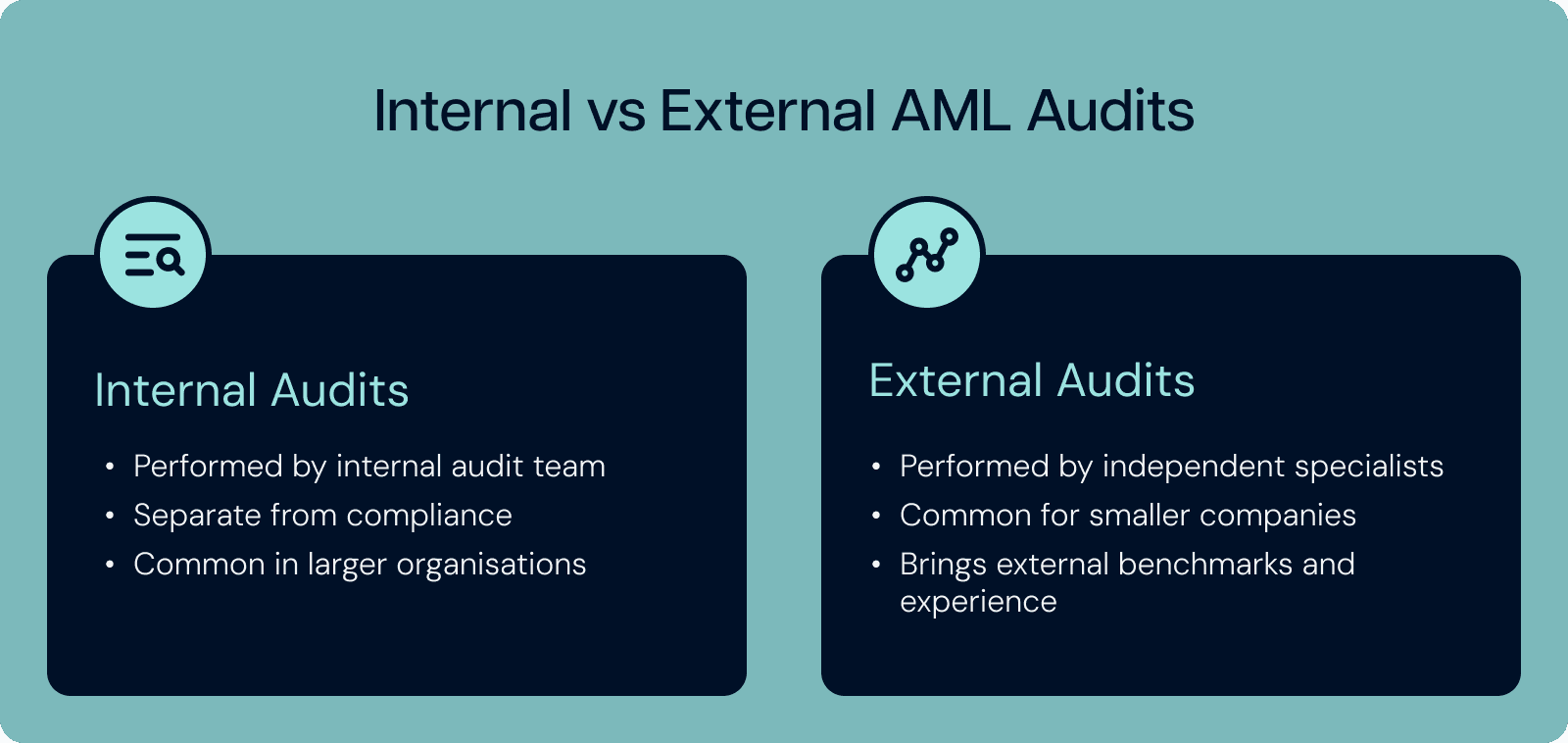
An internal AML audit is typically performed by the institution’s internal audit function. The internal team possesses institutional knowledge, understands internal systems, and can conduct recurring reviews with operational efficiency. However, independence must be preserved. Internal auditors must not have operational responsibility for AML functions they evaluate.
External AML Compliance Audit
An external AML compliance audit provides an independent third-party perspective. External auditors often bring specialized AML expertise, cross-jurisdictional knowledge, and benchmarking insights. Institutions undergoing regulatory remediation, expansion into high-risk markets, or significant system upgrades often benefit from external validation.
AML Audit Requirements, Regulatory Expectations and Industry Standards
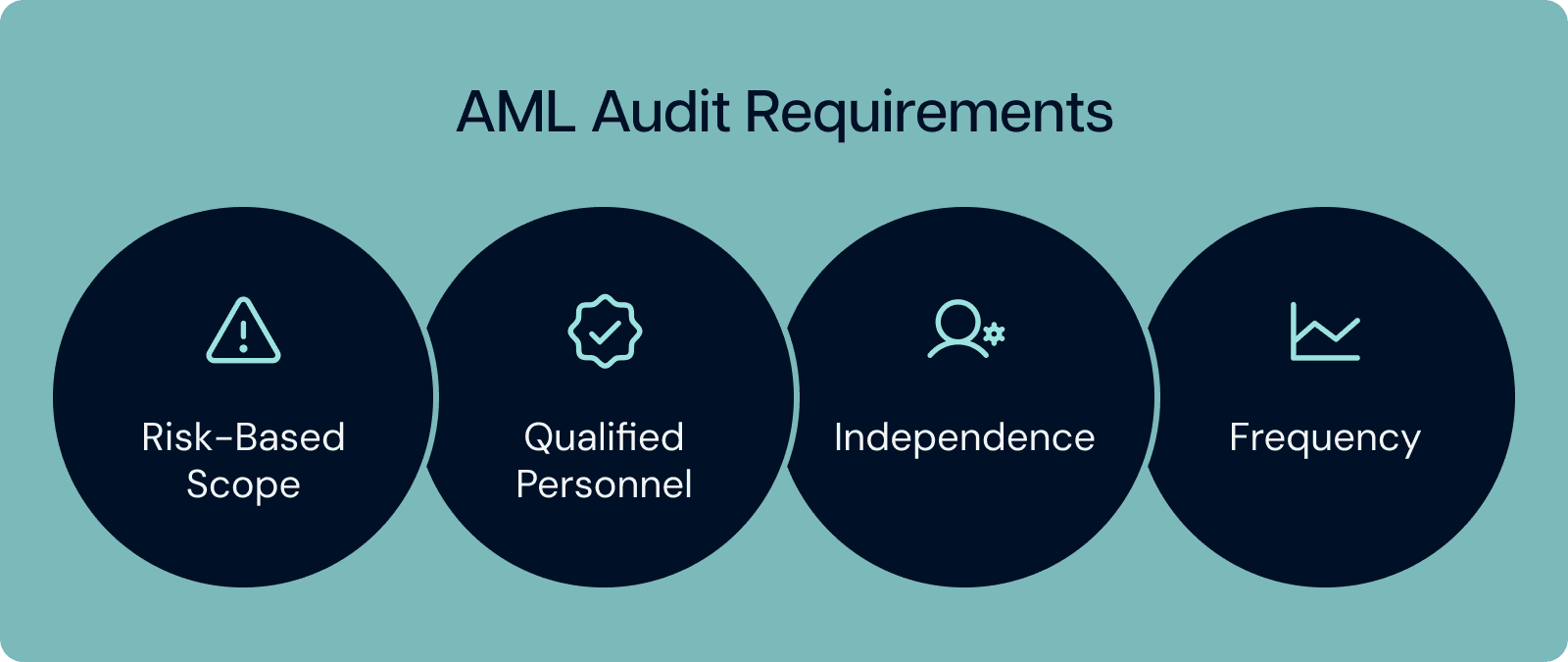
Regulators expect AML audits to be risk-based, independent, and appropriately documented.
Risk-Based Scope
Audit scope must align with the institution’s AML risk assessment. High-risk products, customer segments, or geographic exposures require deeper review. A static audit plan disconnected from risk exposure may be viewed as inadequate.
Qualified Personnel
Audit teams must possess sufficient technical knowledge of AML regulatory frameworks, transaction monitoring systems, sanctions controls, and investigative processes.
Independence
Auditors must maintain functional independence from AML operations. Reporting lines often flow to the board audit committee or equivalent governance body.
Frequency
High-risk institutions typically conduct AML audits annually. Lower-risk entities may follow longer cycles, supplemented by targeted reviews.
The AML Audit Process
The AML audit process follows a structured methodology.
Planning and Scoping
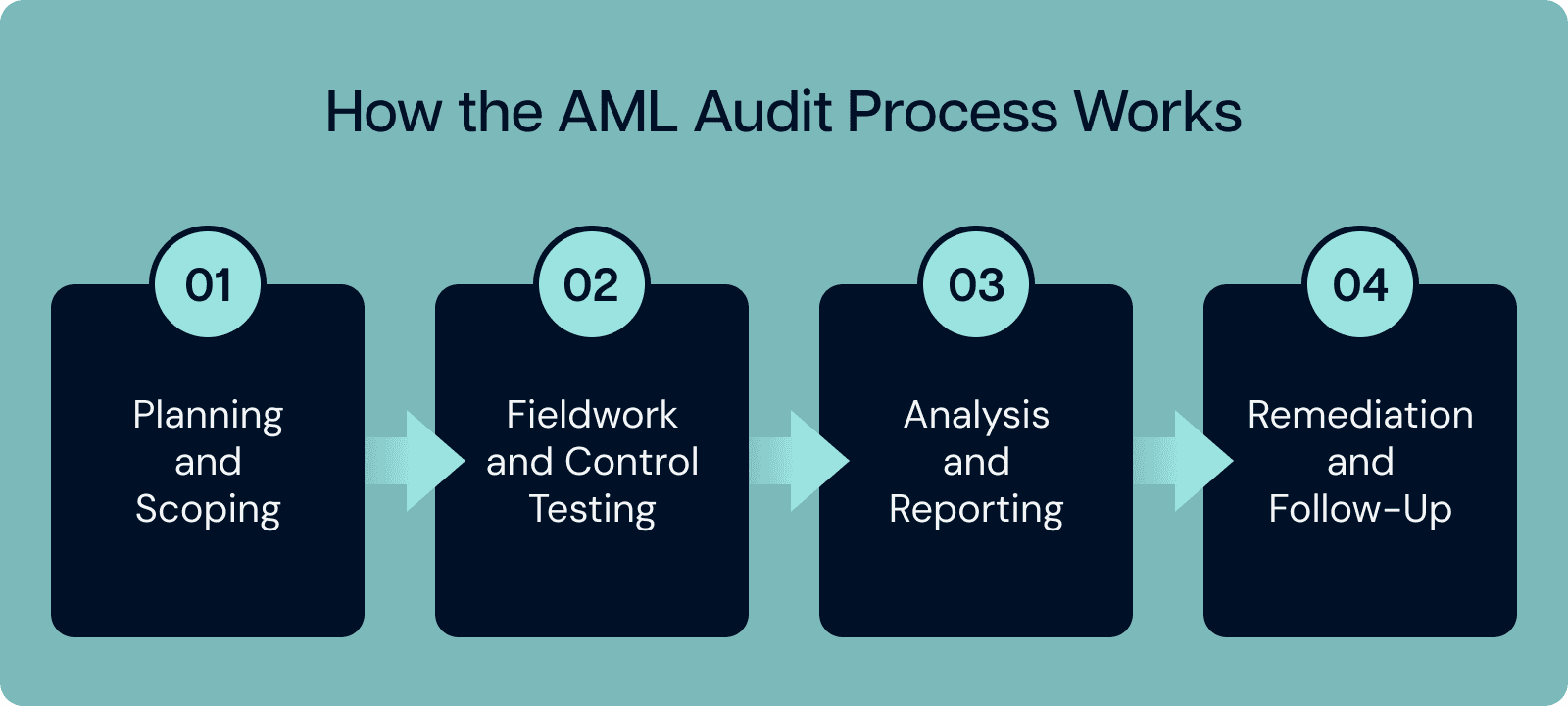
An AML audit typically follows a structured lifecycle: planning, fieldwork, analysis, reporting, and follow-up.
During planning, auditors define scope and objectives based on the institutional AML risk assessment. Prior audit findings, regulatory observations, and business changes inform scoping decisions.
Fieldwork and Control Testing
Fieldwork involves substantive testing. Auditors review customer files to evaluate CDD and EDD completeness. They examine transaction monitoring alerts to assess investigation quality and timeliness. Sanctions screening controls are evaluated for list updates, false positive handling, and escalation processes. Suspicious activity reports are reviewed for timeliness and adequacy of narrative documentation.
Analysis and Reporting
Analysis focuses on identifying control gaps and determining root causes. Findings are assessed based on risk severity and regulatory exposure.
Reporting formalizes conclusions and recommendations. Effective reports balance executive clarity with detailed evidence supporting each finding.
Remediation and Follow-Up
Follow-up ensures remediation actions are implemented and validated.
AML Audit Risk Assessment
AML audit risk assessment evaluates three dimensions:
Inherent risk: Customer types, products, jurisdictions, delivery channels.
Control effectiveness: Strength and design of mitigating controls.
Residual risk: Remaining exposure after controls are applied.
Audit scope and testing intensity are driven by residual risk levels. Institutions with complex cross-border exposure or high-risk customer bases require deeper control validation.
What an AML Compliance Audit Reviews
The scope of an AML compliance audit extends across all core components of the institution’s AML/CFT compliance framework.
Governance and Risk Assessment
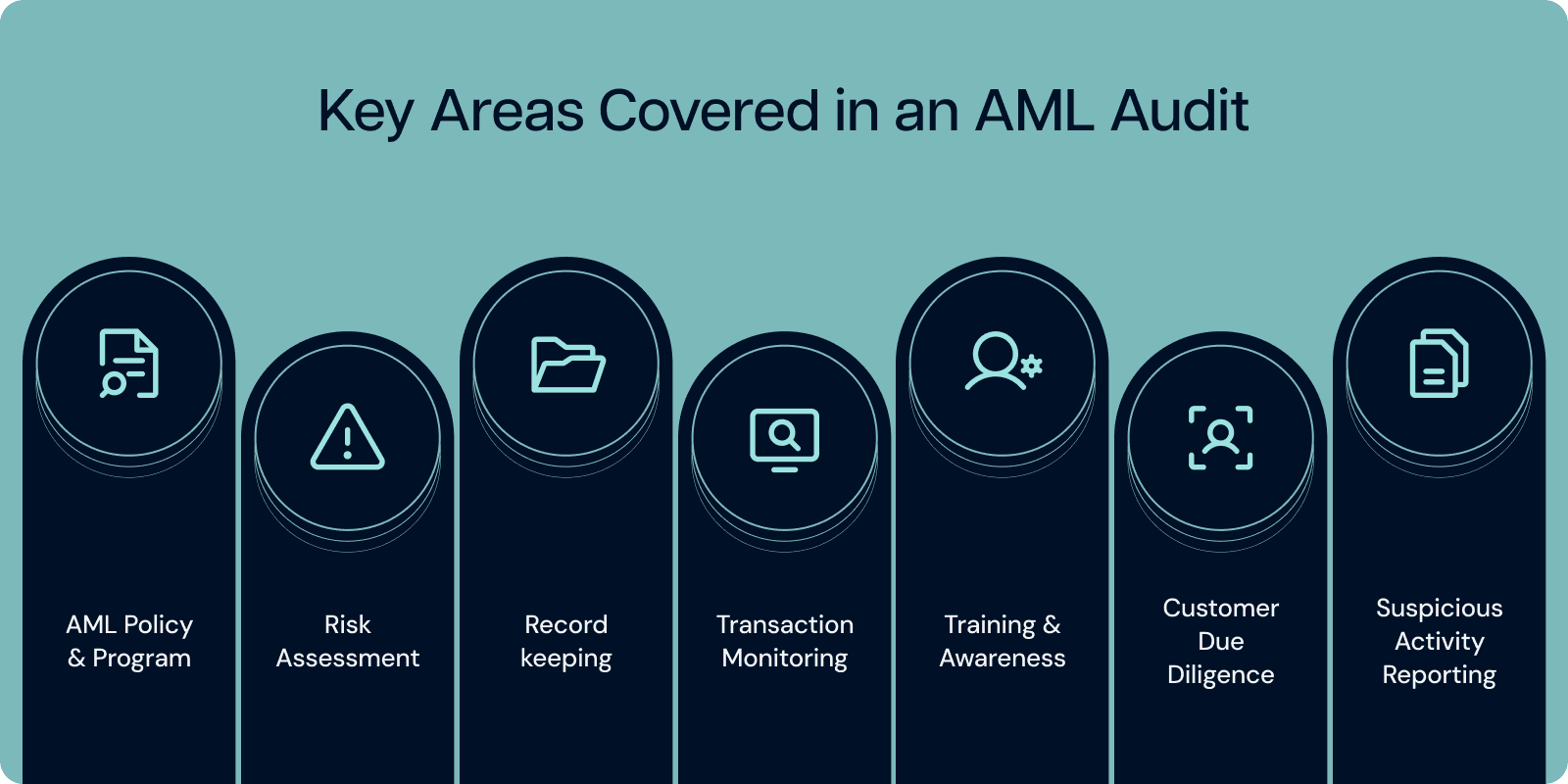
An AML compliance audit evaluates the full AML/CFT framework, typically including governance, risk assessment, CDD and EDD processes, transaction monitoring systems, sanctions screening, suspicious activity reporting, training, and record-keeping.
Governance review assesses board oversight, reporting lines, policy approval processes, and compliance independence. Risk assessments are evaluated for methodological rigor, data accuracy, and alignment with actual risk exposure.
Customer Due Diligence and Enhanced Due Diligence
Customer due diligence files are tested for completeness, accuracy, and appropriate risk classification. Enhanced due diligence procedures are reviewed for high-risk customers, politically exposed persons, and high-risk jurisdictions.
Transaction Monitoring and Sanctions Controls
Transaction monitoring systems are evaluated for scenario design, threshold calibration, alert investigation quality, and documentation standards. Suspicious activity reporting timelines are tested against regulatory requirements.
Sanctions controls are reviewed for list accuracy, screening coverage, and blocked or rejected transaction management.
Training and Record-Keeping
Training programs are assessed for coverage, frequency, and documentation. Record retention practices are evaluated for regulatory compliance.
AML Audit Checklist and Preparation
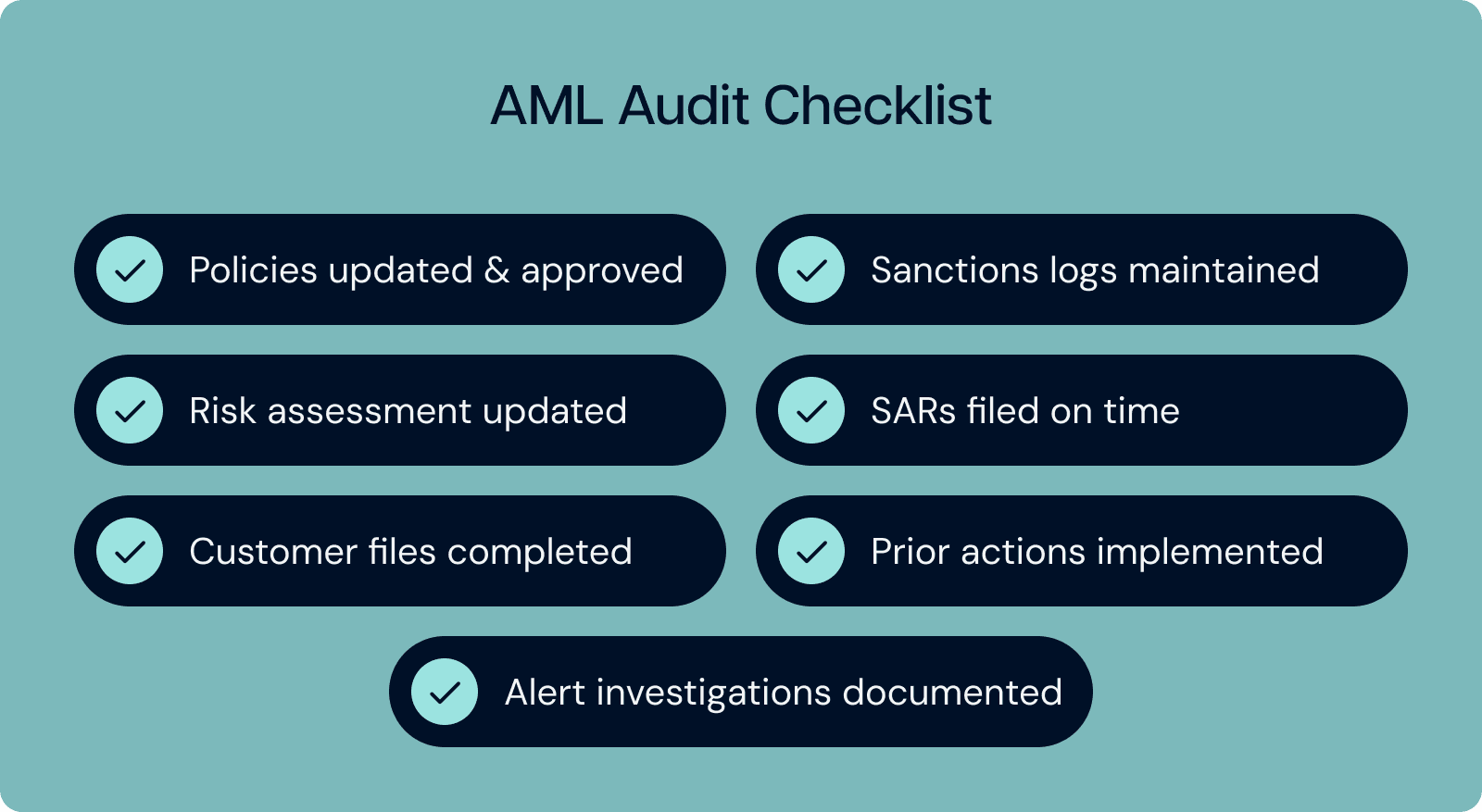
Preparation reduces findings and improves audit efficiency. Organizations should ensure:
AML policies are current and board-approved.
The enterprise-wide AML risk assessment is up to date.
Customer files are complete and risk-rated appropriately.
Monitoring alerts include documented investigations.
Sanctions screening logs are maintained.
SARs are filed within regulatory timelines.
Corrective action plans from prior audits are fully implemented.
Pre-audit internal reviews often reduce remediation burden during formal audits.
The AML Audit Report
The AML audit report communicates audit scope, methodology, findings, and recommendations. It typically begins with an executive summary outlining overall effectiveness and key issues.
Detailed findings describe observed deficiencies, associated risks, and regulatory implications. Risk ratings prioritize remediation. Recommendations should be practical, measurable, and time-bound.
Clear reporting supports governance oversight and facilitates structured corrective action planning.
Common AML Audit Findings and Root Causes
Common findings include incomplete CDD documentation, inconsistent risk ratings, inadequate EDD files, weak transaction monitoring investigations, delayed SAR submissions, and ineffective sanctions screening processes.
Root causes often stem from insufficient staffing, outdated procedures, legacy technology constraints, or governance oversight gaps. Sustainable remediation requires addressing systemic weaknesses rather than isolated control failures.
Common Structural Weaknesses in AML Policies
Beyond standard findings such as incomplete CDD files or delayed SAR submissions, regulators increasingly scrutinize the quality and precision of AML policy drafting.
A recurring regulatory concern is the use of discretionary language in AML policies, for example “may conduct enhanced due diligence” or “where appropriate.” When controls are framed as optional rather than mandatory under clearly defined triggers, regulators may view this as a governance weakness. Ambiguity can lead to inconsistent application and weak audit defensibility.
Supervisors are also criticizing:
Lack of clearly defined thresholds for EDD triggers
Undefined or poorly documented risk scoring methodologies
No documented audit trail for transaction monitoring rule calibration
Inconsistent sanctions screening coverage across products or lifecycle stages
Absence of a structured remediation tracking methodology
In 2026, vague drafting and undocumented methodologies are increasingly viewed not as stylistic issues, but as structural control weaknesses. Precision in policy language is now a regulatory expectation, not an optional refinement.
Limitations of Manual AML Audits and the Role of Automation
Manual AML audits rely heavily on sampling and human review, which can introduce bias, increase the risk of error, and limit visibility into full data populations. In high-volume environments, this approach may constrain the ability to detect systemic weaknesses.
Automated audit tools like AML Reactor enhance scalability and consistency by enabling broader data analysis, structured audit trails, and more transparent control validation. Increasingly, regulators view data-driven audit capability as a component of operational effectiveness rather than a technological enhancement.
What Happens After the Audit
The period following completion of an AML audit is essential to ensuring that identified findings are appropriately remediated and that control effectiveness is sustainably enhanced.
Corrective Action Planning
Following report issuance, management develops corrective action plans outlining remediation steps, responsible parties, and timelines. Progress is tracked and reported to governance committees.
Validation and Ongoing Monitoring
Independent validation confirms that corrective actions effectively address findings. Institutions that demonstrate disciplined remediation reduce regulatory scrutiny and enforcement exposure.
Top AML Penalties and Regulatory Actions in 2025
Regulatory enforcement in 2025 reinforced that AML control failures continue to carry substantial financial and operational consequences. Regulators across the United States, United Kingdom and European Union imposed significant monetary penalties for deficiencies in transaction monitoring, sanctions screening and governance oversight. While enforcement outcomes vary by jurisdiction, several high-profile actions illustrate recurring supervisory themes.
TD Bank: Multibillion-Dollar U.S. Settlement for AML Deficiencies
In 2025, TD Bank entered into a multibillion-dollar settlement with U.S. authorities relating to sustained weaknesses in its AML compliance framework. Regulatory findings cited deficiencies in transaction monitoring, suspicious activity reporting and overall control effectiveness. Authorities emphasized that monitoring systems must be properly calibrated, supported by adequate resources and capable of identifying large-scale illicit activity in a timely manner.
The case highlighted that prolonged remediation delays and repeated internal findings materially increase enforcement risk and financial exposure.
Binance: Ongoing Global Enforcement and Compliance Oversight
Throughout 2025, continued regulatory actions and supervisory measures affecting Binance reinforced expectations regarding sanctions screening, customer due diligence and cross-border AML governance. Regulatory commentary focused on weaknesses in enterprise-wide risk assessment, monitoring oversight and centralized compliance coordination.
The enforcement environment demonstrated how global institutions face compounded scrutiny when AML controls are inconsistently implemented across jurisdictions or lack unified governance structures.
European Banking Enforcement: Governance and Risk Assessment Deficiencies
Multiple EU-based financial institutions faced significant penalties in 2025 for weaknesses in risk assessments, inadequate enhanced due diligence procedures and insufficient board-level oversight of AML compliance. Supervisory authorities reiterated that AML frameworks must be proportionate to documented risk exposure and supported by demonstrable governance accountability.
Regulatory Themes in 2026
These enforcement actions highlight consistent regulatory themes: ineffective transaction monitoring, weak customer due diligence, insufficient governance oversight, and delayed remediation.
For compliance professionals, the message is clear. AML audits must go beyond policy validation and assess operational effectiveness. Regulators expect evidence of meaningful risk mitigation, not procedural formality.
Conclusion
An AML audit is a cornerstone of a mature AML compliance program. It provides independent assurance, strengthens governance oversight, and identifies control weaknesses before they result in regulatory enforcement.
In 2026, regulators expect demonstrable operational effectiveness, not policy formality. Institutions that implement risk-based, well-documented, and independent AML audit programs position themselves to withstand regulatory scrutiny and reduce financial crime exposure.
Whether conducted internally or through independent providers such as AML Reactor, AML compliance audits must be integrated into the broader AML risk management lifecycle.
A robust AML audit program is not merely a compliance obligation. It is a strategic safeguard for institutional integrity and long-term resilience, which is why you should get one today.
FAQs
How Often is an AML Audit Required?
AML audit frequency depends on the institution’s regulatory obligations, risk profile and jurisdiction. High-risk institutions typically conduct audits annually, while lower-risk entities may follow a 18 to 36 month cycle.
Who Performs AML Audits?
What are the AML Audit Requirements by Country?
What are AML Independent Testing Requirements?
Featured articles